SpencerMayes
Building Services Consultants
020 7566 0911
Company & Industry News
Kew Gardens Opens Carbon Garden
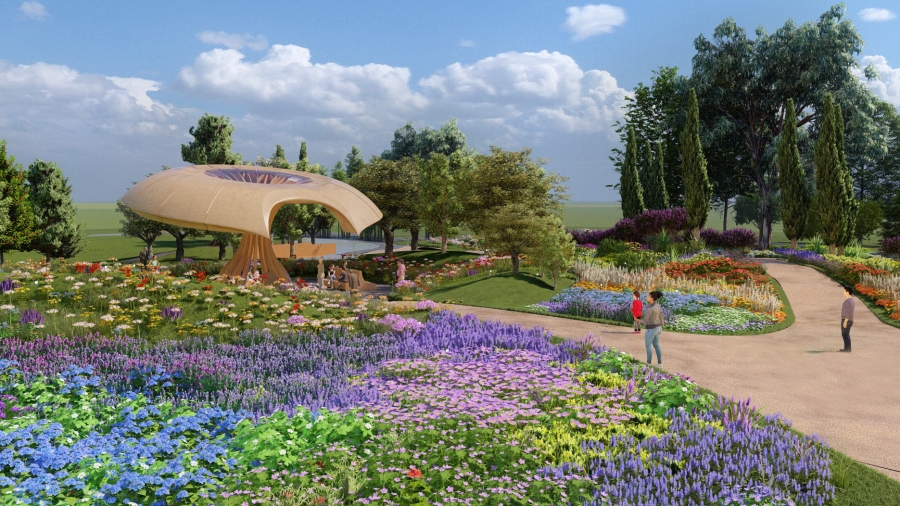
(The pavilion in the Carbon Garden, designed by Mizzi Studio © Mizzi Studio)
This summer on 25 July 2025, Kew Gardens in London unveiled one of its most ambitious garden projects in recent years: the Carbon Garden. This permanent new garden aims to reveal the invisible, bringing to life the critical role carbon plays in sustaining life on Earth, communicating the scale of the climate crisis, and sharing the extraordinary potential of the natural world to combat it.
SpencerMayes worked with Royal Botanic Gardens, Kew to assist with the design of the Mechanical & Electrical Services for the creation of the Carbon Garden.
What is carbon?
Quite literally ‘stardust’, carbon is the building block of life - it can be found in all living things. It exists in the air, it is dissolved into our oceans and rivers, it is found in organic matter in soils and is stored deep underground in sedimentary rocks and fossil fuels (99% of carbon on Earth is stored underground[i]). However, the balance has been upset, and human activities are releasing too much carbon dioxide into the atmosphere, trapping heat and warming the planet. Plants and fungi are our natural allies in climate repair and hold the power to capture carbon and restore balance.
The Carbon Garden
A curated selection of herbaceous perennials take inspiration from Reading University’s climate stripes[1], illustrating the dramatic rise in global average temperatures over time. Plant highlights include Achillea ‘Moonshine’, ‘Paprika’ and ‘Red Velvet’, and Hydrangea serrata ‘Bluebird’. This powerful visual statement welcomes visitors into the garden alongside an exposed coal seam showing fossilized plants, highlighting the connection between plants and fossil fuels.
Delving into links between carbon emissions and climate change, a dry garden begins to showcase ways we can work together with plants to adapt to a changing climate. Here, drought-tolerant plants such as Parry's agave (Agave parryi) and lavendar dominate, illustrative of the plants we might look to for London gardens in 30 years[ii].
Nature offers hope through its extraordinary capacity to sequester and lock in carbon. 35 new trees have been selected for their resilience to projected future climate conditions. Trees play a critical role in helping urban areas adapt to climate change thanks to the myriad of ecosystem services they offer, including absorption of carbon dioxide, shade and shelter provision, and improvement of air quality by filtering out pollutants.
A rain garden illustrates ways we can manage water flow, prevent soil erosion, reduce flooding, recharge moisture into the soil and support moisture-tolerant plants that maintain soil stability and carbon storage. Grasslands, wildflower meadows and native hedgerows will boost biodiversity and lock in carbon, as biodiverse habitats are more resilient and better at storing carbon than monocultures.
Appearing to grow from the centre of the Carbon Garden as a symbolic fungal fruiting body is a pavilion designed by Mizzi Studio. Inspired by the symbiotic relationship between plants and fungi, the materials and structure have been modelled on biological processes, and the pavilion has been created using natural materials. A forward-tilted canopy directs rainwater into the rain garden, and the sheltered space will support school visits and community activities.
The Carbon Garden encourages visitors to become advocates for nature, highlighting actions we can all take in our everyday lives to support the health of plants and the planet.
Richard Wilford, designer of the Carbon Garden and Manager of Garden Design at RBG Kew says: ‘The Carbon Garden offers a unique opportunity to showcase our ongoing research, combining scientific insight with thoughtful design and beautiful planting to highlight the role of carbon in our lives, how it moves through the environment and how plants and fungi can help us tackle climate change. We hope the Carbon Garden inspires visitors to act and join us in shaping a more sustainable, resilient future for life on our planet.’
[1] Climate stripes are a visual tool created by the University of Reading, to show how global average temperatures have risen.
[i] Marshall, M. (2019). We've totted up all Earth's carbon - and 99 per cent is underground. New Scientist. https://www.newscientist.com/article/2218180-weve-totted-up-all-earths-carbon-and-99-per-cent-is-underground/
[ii] Bastin, J.F., et al. (2019). Understanding climate change from a global analysis of city analogues. PLOS ONE 14(10): e0217592. https://doi.org/10.1371/journal.pone.0217592